Showing posts with label Biblical Errors. Show all posts

Thursday, 29 March 2007

Intentional Changes to the New Testament - Factual and Interpretive Errors

The following quote comes from, Misquoting Jesus: The Story Behind Who Changed the Bible and Why pp. 94-95 by Bart D. Ehrman.

Sometimes scribes changed their texts because they thought the text contained a factual error. This appears to be the case at the very beginning of Mark, where the author introduces his Gospel by saying, "Just as it is written in Isaiah the prophet, 'behold I am sending a messenger before your face...Make straight the paths.'" The problem is that the beginning of the quotation is not from Isaiah at all but represents a combination of a passage from Exod. 23:20 and one from Mal. 3:1. Scribes recognised that this was a difficulty and so changed the text, making it say, "Just as is written in the prophets..." Now there is no problem with the misattribution of the quotation. But there can be little doubt concerning what Mark originally wrote: the attribution to Isaiah is found in our earliest and best manuscripts.

On occasion the "error" that a scribe attempted to correct was not factual, but interpretive. A well-known example comes in Matt. 24:36, where Jesus is predicting the end of the age and says that, "concerning that day and hour, no one knows-not the angels in heaven, nor even the Son, but only the Father." Scribes found this passage difficult: the Son of God, Jesus himself, does not know when the end will come? How could that be? Isn't he all-knowing? To resolve the problem, some scribes simply modified the text by taking out the words "nor even the Son." Now the angels may be ignorant, but the Son of God isn't.

Misquoting Jesus: The Story Behind Who Changed the Bible and Why

The popular perception of the Bible as a divinely perfect book receives scant support from Ehrman, who sees in Holy Writ ample evidence of human fallibility and ecclesiastical politics. Though himself schooled in evangelical literalism, Ehrman has come to regard his earlier faith in the inerrant inspiration of the Bible as misguided, given that the original texts have disappeared and that the extant texts available do not agree with one another. Most of the textual discrepancies, Ehrman acknowledges, matter little, but some do profoundly affect religious doctrine. To assess how ignorant or theologically manipulative scribes may have changed the biblical text, modern scholars have developed procedures for comparing diverging texts. And in language accessible to nonspecialists, Ehrman explains these procedures and their results. He further explains why textual criticism has frequently sparked intense controversy, especially among scripture-alone Protestants. In discounting not only the authenticity of existing manuscripts but also the inspiration of the original writers, Ehrman will deeply divide his readers. Although he addresses a popular audience, he undercuts the very religious attitudes that have made the Bible a popular book. Still, this is a useful overview for biblical history collections. Bryce Christensen
Copyright © American Library Association. All rights reserved --This text refers to the Hardcover edition.

Wednesday, 21 March 2007

Saul, Saul, which was it?

I mentioned the contradictions in Paul's conversion stories here, but it seems that there is yet another major contradiction that either calls Galatians or Acts into question.

In Galatians, a largely undisputed epistle of Paul, he says that he did not straight away go to Jerusalem to see the other Apostles after his conversion.

But when he who had set me apart before I was born, and had called me through his grace, was pleased to reveal his Son to me, in order that I might preach him among the Gentiles, I did not confer with flesh and blood, nor did I go up to Jerusalem to those who were apostles before me, but I went away into Arabia; and again I returned to Damascus. Then after three years I went up to Jerusalem to visit Cephas, and remained with him fifteen days. But I saw none of the other apostles except James the Lord's brother. (In what I am writing to you, before God, I do not lie!) (Galatians 1:15-20 RSV)
But then the account in Acts say the exact opposite. After he left Damascus the first time he went straight to Jerusalem and eventually mixed freely with the Apostles.
And when he had come to Jerusalem he attempted to join the disciples; and they were all afraid of him, for they did not believe that he was a disciple. But Barnabas took him, and brought him to the apostles, and declared to them how on the road he had seen the Lord, who spoke to him, and how at Damascus he had preached boldly in the name of Jesus. So he went in and out among them at Jerusalem, (Acts 9:26-28 RSV)
This contradiction matters as Paul is making a serious point in Galatians which testifies to his right to claim Apostleship. Paul claims to have been called directly by God. His Apostleship was not given by other Apostles and he did not confer with them. If the Acts account is true then Paul's argument here in Galatians is undermined. He even goes so far to assure us that he isn't lying.

Jesus Gets it Wrong...

This one is a problem for those who hold to a perfect Bible as Jesus refers to a story from the Old Testament but gets a major detail wrong. In Mark 2 Jesus says the story happened "when Abi'athar was high priest".

And he said to them, "Have you never read what David did, when he was in need and was hungry, he and those who were with him: how he entered the house of God, when Abi'athar was high priest, and ate the bread of the Presence, which it is not lawful for any but the priests to eat, and also gave it to those who were with him?" (Mark 2:25-26 RSV)
But when one looks back to the Old Testament telling of the story we see that Abi'athar was not yet the high priest, rather it was his father Ahim'elech.
Then came David to Nob to Ahim'elech the priest; and Ahim'elech came to meet David trembling, and said to him, "Why are you alone, and no one with you?" (1 Samuel 21:1)
The NIV Bible tries to accommodate this apparent error by saying, "In the days of Abiathar the high priest" (Mark 2:26 NIV) thus implying that it happened when Abi'athar was alive but not necessarily holding the office of high priest (at that time). But if you read most translations you will see that this is just creative translating by our Evangelical friends responsible for the NIV.

Saturday, 3 March 2007

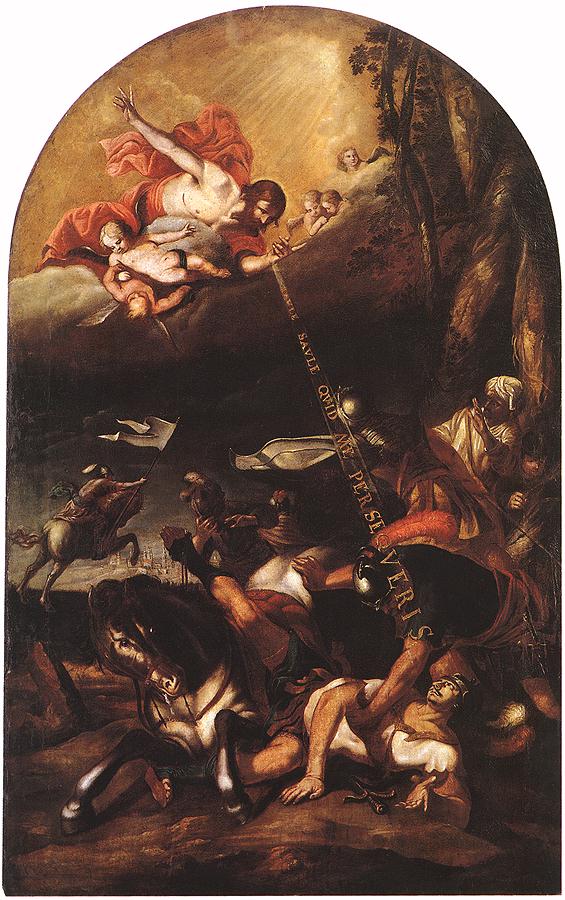
Saul, Saul, why getteth thee thou story wrong?

What is up with Christians and the story of Paul's conversion? Why do they throw this story up as 'evidence' or 'proof' of the Christian religion? As a Christian I always thought the story of Paul's conversion was relevant in that it was the conversion account of the most influential Apostle for the later Church, but proof or evidence? Why would a non-believer be moved by the account of an Apostle's conversion? I never used it in my witnessing as I could just hear non-believers saying, "So? How do we even know that is a true story?" or "Who cares? Who's he?"

Yet for many Christians this story holds water for some reason. Evangelists would sometimes preach the story and even get a response at the altar-call. I never understood that. As I ponder it I think that maybe it is the drama of it. The hard-ass persecutor gets zapped and becomes the hard-ass Apostle. I guess that much of it makes a good story. Perhaps there are some archetypes in there that resonate with us. Like Darth Vader's deathbed conversion at the end of Return of the Jedi, we all love it when bad guys turn good.

The story of Paul's conversion is told 3 times in the book of Acts (9; 22; 26). And yep, you guessed it, the stories don't match up. The accounts are not only different but in some places, irreconcilable.

After the light hits Paul and Jesus talks to Paul the stories conflict.

Act 9:7 And the men which journeyed with him stood speechless, hearing a voice, but seeing no man.
Act 22:9 And they that were with me saw indeed the light, and were afraid; but they heard not the voice of him that spake to me.

OK, so there we have the guys with Paul hearing the voice and then not hearing the voice. So which one is it? It can't be both.

Act 9:4, 7, 8 And he fell to the earth, and heard a voice saying unto him, Saul, Saul, why persecutest thou me?...And the men which journeyed with him stood speechless... And Saul arose from the earth
Act 22:7 And I fell unto the ground, and heard a voice saying unto me, Saul, Saul, why persecutest thou me?
Act 26:14 And when we were all fallen to the earth, I heard a voice speaking unto me, and saying in the Hebrew tongue, Saul, Saul, why persecutest thou me?

And here we have Acts 9 & 22 saying it was only Paul who fell and then chapter 9 even saying that that the other men were standing, but chapter 26 says they all fell. Which is it? It can't be both. Either Paul fell alone, or they all fell together.

Go and read the NIV to see how the Evangelicals involved in that translation have amended this apparent error. They have changed the word 'hear' in Acts 22:9 to 'understand' which is something earlier and later translations including the KJV and RSV do not do for good reason. The Greek word for 'hear' in verse 9 simply shouldn't be translated as 'understand' (see here).

One guy fell, they all fell. One guy heard a voice they all heard heard a voice. How did I ever believe God had a hand in that book?